
III.D.1 Neck: Muscles & Nerves: Page 1 of 6
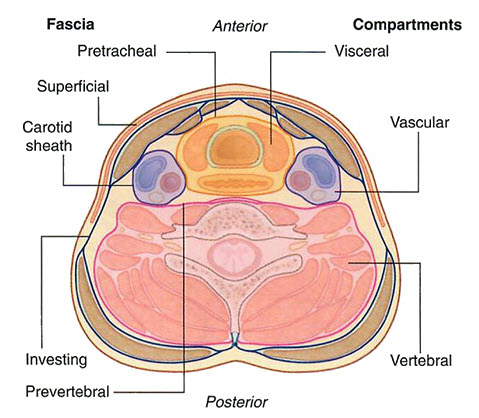
OBJECTIVES:9.1.1 Demonstrate the prevertebral muscles and indicate their major actions and the relationship of the muscle groups to the deep layers of cervical fascia. 9.1.2 Trace the course of the branches of cranial nerves VII, IX, X, XI, and XII in the neck. Predict the functional deficits, which would result from damage to cranial nerves VII, IX, X, XI, and XII or their branches in the neck region. 9.1.3 Trace the course and distribution of the sensory and motor branches of the cervical plexus in the neck and their relationship to major bony, muscular, or vascular landmarks in the region. Predict the functional deficits, which would result from their damage. Identify the cervical sympathetic ganglia and trunk. 9.1.4 Trace the pathways for venous drainage from the neck. Note the regions drained by tributaries of the internal and external jugular veins and subclavian veins. |
READINGS:Moore's COA: Pages 996-997, 1004-1013, 1021, 1024-1026. See the blue boxes on pages 998 for clinical correlations. See the yellow box on page 998 for "The Bottom Line." |
 |
| 🔍 Compartments |

Now let's build the components of the posterior (prevertebral) compartment of the neck. We will focus on the prevertebral portion but please review the muscles of the back which are also part of this compartment.
| Begin with the cranium and vertebrae with mandible removed for clarity. | |
| Add the posterior scalene. | |
| Add the middle scalene. |